Wiki
Resources on running FUMA modules and interpreting results.
Documentation and tutorial for FUMA v2.0.0 and beyond will be hosted on: link to documentation
Overview of FUMA v2.0.0 release:
1. SNP2GENE module is updated with additional xQTLs datasets for xQTLs mapping. Click here for documentation.
2. FLAMES module is added. Click here for documentation.
3. QTLs Analysis module is added. Click here for documentation.
4. New job retention policy: SNP2GENE jobs that were created prior to Jan 01 2023 were removed from the FUMA server.
SNP2GENE
Resources on running SNP2GENE on FUMA
What is new in SNP2GENE in FUMA v2.0.0?
Cell Type
Resources on running Cell Type on FUMA
Submit a Cell Type job
Viewing results from a Cell Type job
FLAMES
Resources on running FLAMES on FUMA
Introduction to the FLAMES module
QTLs Analysis
Resources on running QTLs Analysis on FUMA
Introduction to the QTLs Analysis module
FAQs
In order to prevent single users to occupy the entire server, there is a job limit of 10 jobs per user.
Each user can store at most 100 SNP2GENE jobs on the FUMA server (policy updated as of v1.6.5).
Currently, there is no restriction on the number of GENE2FUNC and Cell Type jobs stored on the FUMA server because these jobs tend to be small in size (but subject to change).
All faulty jobs will be deleted after 1 month.
All jobs prior to 2023-01-01 have been deleted (policay updated as of v2.0.0).
Currently, there is no restriction on the number of GENE2FUNC and Cell Type jobs stored on the FUMA server because these jobs tend to be small in size (but subject to change).
All faulty jobs will be deleted after 1 month.
All jobs prior to 2023-01-01 have been deleted (policay updated as of v2.0.0).
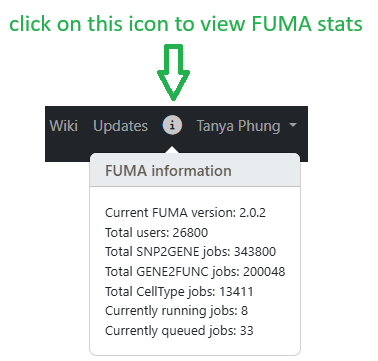
FUMA is a free service we provide for the advancement of science, this also means that there is a limited amount of computational resources to go around. At any one time there can be a maximum of 8 jobs running. If there are many jobs being submitted, the jobs will be in the queue. You can click on the i icon next to your name to view the number of queued jobs.
Links
For scRNA-seq datasets in cell type analysis section, please see tutorial for links and references.
| Data source/tool | Used for | Links | Last update | Reference |
|---|---|---|---|---|
| 1000 Genome Project Phase 3 | Reference panel used to compute r2 and MAF. |
Info: http://www.internationalgenome.org/ Data: ftp://ftp.1000genomes.ebi.ac.uk/vol1/ftp/release/20130502/ |
27 May 2019 |
1000 Genomes Project Consortium, et al. 2015. A global reference for human genetic variation. Nature. 526, 68-74. PMID:26432245 |
| PLINK v1.9 | Used to compute r2 and MAF. | Info and download: https://www.cog-genomics.org/plink2 | 27 May 2019 |
Purcell, S., et al. 2007. PLINK: A tool set for whole-genome association and population-based linkage analyses. Am. J. Hum. Genet. 81, 559-575. PMID:17701901 |
| MAGMA v1.08 | Used for gene analysis and gene-set analysis. | Info and download: https://ctg.cncr.nl/software/magma | 9 Sep 2020 |
de Leeuw, C., et al. 2015. MAGMA: Generalized gene-set analysis of GWAS data. PLoS Comput. Biol. 11, DOI:10.1371/journal.pcbi.1004219. PMCID:PMC4401657 |
| ANNOVAR | A variant annotation tool used to obtain functional consequences of SNPs on gene functions. | Info and download: http://annovar.openbioinformatics.org/en/latest/ | 5 Dec 2016 |
Wang, K., Li, M. and Hakonarson, H. 2010. ANNOVAR: functional annotation of genetic variants from high-throughput sequencing data. Nucleic Acids Res. 38:e164 PMID:20601685 |
| CADD v1.4 | A deleterious score of variants computed by integrating 63 functional annotations. The higher the score, the more deleterious. |
Info: http://cadd.gs.washington.edu/ Data: http://cadd.gs.washington.edu/download |
27 May 2019 |
Kicher, M., et al. 2014. A general framework for estimating the relative pathogeneticity of human genetic variants. Nat. Genet. 46, 310-315. PMID:24487276 |
| RegulomeDB v1.1 | A categorical score to guide interpretation of regulatory variants. |
Info: http://regulomedb.org/index Data: http://regulomedb.org/downloads/RegulomeDB.dbSNP141.txt.gz |
5 Dec 2016 |
Boyle, AP., et al. 2012. Annotation of functional variation in personal genomes using RegulomeDB. Genome Res. 22, 1790-7. PMID:22955989 |
| 15-core chromatin state | Chromatin state for 127 epigenomes was learned by ChromHMM derived from 5 chromatin markers (H3K4me3, H3K4me1, H3K36me3, H3K27me3, H3K9me3). |
Info: http://egg2.wustl.edu/roadmap/web_portal/chr_state_learning.html Data: http://egg2.wustl.edu/roadmap/data/byFileType/chromhmmSegmentations/ChmmModels/coreMarks/jointModel/final/all.mnemonics.bedFiles.tgz |
5 Dec 2016 |
Roadmap Epigenomics Consortium, et al. 2015. Integrative analysis of 111 reference human epigenomes. Nature. 518, 317-330. PMID:25693563 Ernst, J. and Kellis, M. 2012. ChromHMM: automating chromatin-state discovery and characterization. Nat. Methods. 28, 215-6. PMID:22373907 |
| GTEx v6/v7/v8 | eQTLs and gene expression used in the pipeline were obtained from GTEx. |
Info and data: http://www.gtexportal.org/home/ | 14 Oct 2019 |
GTEx Consortium. 2015. Human genomics, The genotype-tissue expression (GTEx) pilot analysis: multitissue gene regulation in humans. Science. 348, 648-60. PMID:25954001 GTEx Consortium. 2017. Genetic effects on gene expression across human tissues. Nature. 550, 204-213. PMID:29022597 Aguet, et al. 2019. The GTEx consortium atlas of genetic regulatory effects across human tissues. bioRxiv. doi: https://doi.org/10.1101/787903. https://doi.org/10.1101/787903 |
| Blood eQTL Browser | eQTLs of blood cells. Only cis-eQTLs with FDR ≤ 0.05 are available in FUMA. | Info and data: http://genenetwork.nl/bloodeqtlbrowser/ | 17 January 2017 |
Westra et al. 2013. Systematic identification of trans eQTLs as putative divers of known disease associations. Nat. Genet. 45, 1238-1243. PMID:24013639 |
| BIOS QTL browser | eQTLs of blood cells in Dutch population. Only cis-eQTLs (gene-level) with FDR ≤ 0.05 are available in FUMA. | Info and data: http://genenetwork.nl/biosqtlbrowser/ | 17 January 2017 |
Zhernakova et al. 2017. Identification of context-dependent expression quantitative trait loci in whole blood. Nat. Genet. 49, 139-145. PMID:27918533 |
| BRAINEAC | eQTLs of 10 brain regions. Cis-eQTLs with nominal P-value < 0.05 are available in FUMA. | Info and data: http://www.braineac.org/ | 26 January 2017 |
Ramasamy et al. 2014. Genetic variability in the regulation of gene expression in ten regions of the human brain. Nat. Neurosci. 17, 1418-1428. PMID:27918533 |
| MuTHER | eQTLs in Adipose, LCL and Skin samples (only cis eQTLs). |
Info: http://www.muther.ac.uk/ Data: http://www.muther.ac.uk/Data.html |
21 January 2018 |
Grundberg et al. 2012. Mapping cis and trans regulatory effects across multiple tissues in twins. Nat. Genet. 44, 1084-1089. PMID:22941192 |
| xQTLServer | eQTLs in dorsolateral prefrontal cortex samples. | Info and data: http://mostafavilab.stat.ubc.ca/xqtl/ | 21 January 2018 |
Ng et al. 2017. An xQTL map integrates the genetic architecture of the human brain's transcriptome and epigenome. Nat. Neurosci. 20, 1418-1426. PMID:28869584 |
| CommonMind Consortium | eQTLs in brain samples. Both cis and trans eQTLs are available | Info and data: https://www.synapse.org//#!Synapse:syn5585484 | 21 January 2018 |
Fromer et al. 2016. Gene expression elucidates functional impact of polygenic risk for schizophrenia. Nat. Neurosci. 16, 1442-1453. PMID:27668389 |
| eQTLGen | Meta-analysis of cis and trans eQTLs based on 37 data sets (in total of 31,684 individuals). |
Info: http://www.eqtlgen.org/index.html Data: https://molgenis26.gcc.rug.nl/downloads/eqtlgen/cis-eqtl/cis-eQTLs_full_20180905.txt.gz, https://molgenis26.gcc.rug.nl/downloads/eqtlgen/trans-eqtl/trans-eQTL_significant_20181017.txt.gz |
20 Oct 2018 |
Vosa et al. 2018. Unraveling the polygenic architecture of complex traits using blood eQTL meta-analysis. bioRxiv https://doi.org/10.1101/447367 |
| DICE | eQTLs of 15 types of immune cells. |
Info: https://dice-database.org/landing Data: https://dice-database.org/downloads |
27 May 2019 |
Schmiedel et al. 2018. Impact of genetic polymorphisms on human immune cell gene expression. Cell 175, 1701-1715.e16. PMID:30449622 |
| van der Wijst et al. scRNA eQTLs | eQTLs based on scRNA-seq of 9 cell types. | Info and data: https://molgenis26.target.rug.nl/downloads/scrna-seq/ | 27 May 2019 |
van der Wijst et al. 2018. Single-cell RNA sequencing identifies celltype-specific eQTLs and co-expression QTLs. Nat. Genet. 50, 493-497. PMID:29610479 |
| PsychENCODE | SNP annotations (enhancer, H3K27ac markers), eQTLs and HiC based enhancer-promoter interactions. | Info and data: http://resource.psychencode.org/ | 27 May 2019 |
Wang et al. 2018. Comprehensive functional genomic resource and integrative model for the human brain. Science 14, eaat8464. PMID:30545857 |
| eQTL Catalogue | Gene level eQTL data generated from a variety of studies, where all of the eQTL datasets were produced in a uniform manner. |
Info: https://www.ebi.ac.uk/eqtl/ Data: https://github.com/eQTL-Catalogue/eQTL-Catalogue-resources/blob/master/tabix/tabix_ftp_paths.tsv |
16 March 2020 | See tutorial https://fuma.ctglab.nl/tutorial#eQTLs. |
| EyeGEx | cis-eQTLs from retina. |
Info: https://gtexportal.org/home/datasets Data: https://storage.googleapis.com/gtex_external_datasets/eyegex_data/single_tissue_eqtl_data/Retina.nominal.eQTLs.with_thresholds.tar |
06 October 2021 | See tutorial https://fuma.ctglab.nl/tutorial#eQTLs. |
| InsPIRE | cis-eQTLs from Human pancreatic islets. |
Info: https://zenodo.org/record/3408356 Data: https://zenodo.org/record/3408356/files/InsPIRE_Islets_Gene_eQTLs_Nominal_Pvalues.txt.gz?download=1 |
27 September 2023 | See tutorial https://fuma.ctglab.nl/tutorial#eQTLs. |
| TIGER | cis-eQTLs from Human pancreatic islets. |
Info: http://tiger.bsc.es/downloads Data: http://tiger.bsc.es/assets/tiger_eqtl_stats.tar.gz |
27 September 2023 | See tutorial https://fuma.ctglab.nl/tutorial#eQTLs. |
| FANTOM5 | SNP annotations (enhancer and promoter) and enhancer-promoter correlations. |
Info: http://fantom.gsc.riken.jp/5/ Data: http://fantom.gsc.riken.jp/5/data/, http://slidebase.binf.ku.dk/human_enhancers/presets |
27 May 2019 |
Andersson et al. 2014. An atlas of active enhancers across human cell types and tissues. Nature 507, 455-461. PMID:24670763 FANTOM Consortium. A promoter-level mammalian expression atlas. Nature 507, 462-470. PMID:24670764 Bertin et al. 2017. Linking FANTOM5 CAGE peaks to annotations with CAGEscan. Sci. Data 4, 170147. PMID:28972578 |
| BrainSpan | Gene expression data of developmental brain samples. | Info and data: http://www.brainspan.org/static/download | 31 January 2018 |
Kang et al. 2011. Spatio-temporal transcriptome of the human brain. Nature 478, 483-489. PMID:22031440 |
| GSE87112 (Hi-C) | Hi-C data (significant loops) of 21 tissue/cell types. Pre-processed data (output of Fit-Hi-C) is used in FUMA. | Info and data: https://www.ncbi.nlm.nih.gov/geo/query/acc.cgi?acc=GSE87112 | 9 May 2017 |
Schmitt, A.D. et al. 2016. A compendium of chromatin contact maps reveals spatially active regions in the human genome. Cell Rep. 17, 2042-2059. PMID:27851967 |
| Giusti-Rodriguez et al. 2019 (Hi-C) | Hi-C data (significant loops) of adult and fetal cortex. Only significant loops after Bonferroni correction (Pbon < 0.001) are available. | The data was kindly shared by Patric F. Sullivan. | 13 Feb 2019 |
Giusti-Rodriguez, P. et al. 2019. Using three-dimentional regulatory chromatin interactions from adult and fetal cortex to interpret genetic results for psychiatric disorders and cognitive traits. bioRxiv. https://doi.org/10.1101/406330 |
| Enhancer and promoter regions | Predicted enhancer and promoter regions (including dyadic) from Roadmap Epigenomics Projects. 111 epigenomes are available. | Info: http://egg2.wustl.edu/roadmap/web_portal/DNase_reg.html Data: http://egg2.wustl.edu/roadmap/data/byDataType/dnase/ |
9 May 2017 |
Roadmap Epigenomics Consortium, et al. 2015. Integrative analysis of 111 reference human epigenomes. Nature. 518, 317-330. PMID:25693563 Ernst, J. and Kellis, M. 2012. ChromHMM: automating chromatin-state discovery and characterization. Nat. Methods. 28, 215-6. PMID:22373907 |
| MsigDB v2023.1.Hs | Collection of publicly available gene sets. Data sets include e.g. KEGG, Reactome, BioCarta, GO terms and so on. | Info and data: http://software.broadinstitute.org/gsea/msigdb | 02 Aug 2023 |
Liberzon, A. et al. 2011. Molecular signatures database (MSigDB) 3.0. Bioinformatics. 27, 1739-40. PMID:21546393 |
| WikiPathways v20191010 | The curated biological pathways. |
Info: http://wikipathways.org/index.php/WikiPathways Data: http://data.wikipathways.org/20161110/gmt/wikipathways-20161110-gmt-Homo_sapiens.gmt |
14 Oct 2019 |
Kutmon, M., et al. 2016. WikiPathways: capturing the full diversity of pahtway knowledge. Nucleic Acids Res. 44, 488-494. PMID:26481357 |
| GWAS-catalog e110_r2023-07-20 | A database of reported SNP-trait associations. |
Info: https://www.ebi.ac.uk/gwas/ Data: https://www.ebi.ac.uk/gwas/downloads |
02 Aug 2023 |
MacArthur, J., et al. 2016. The new NHGRI-EBI Catalog of published genome-wide association studies (GWAS Catalog). Nucleic Acids Res. pii:gkw1133. PMID:27899670 |
| DrugBank v5.1.4 | Targeted genes (protein) of drugs in DrugBank was obtained to assign drug ID for input genes. |
Info: https://www.ncbi.nlm.nih.gov/pubmed/27899670 Data: https://www.drugbank.ca/releases/latest#protein-identifiers |
14 Oct 2019 |
Wishart, DS., et al. 2008. DrugBank: a knowledgebase for drugs, drug actions and drug targets. Nucleic Acis Res. 36, D901-6. PMID:18048412 |
| pLI | A gene score annotated to prioritized genes. The score is the probability of being loss-of-function intolerance. |
Info: http://exac.broadinstitute.org/ Data: ftp://ftp.broadinstitute.org/pub/ExAC_release/release0.3.1/functional_gene_constraint |
27 April 2017 |
Lek, M. et al. 2016. Analyses of protein-coding genetic variation in 60,706 humans. Nature. 536, 285-291. PMID:27535533 |
| ncRVIS | A gene score annotated to prioritized genes. The score is the non-coding residual variation intolerance score. |
Info: http://journals.plos.org/plosgenetics/article?id=10.1371/journal.pgen.1005492 Data: http://journals.plos.org/plosgenetics/article/file?type=supplementary&id=info:doi/10.1371/journal.pgen.1005492.s011 |
27 April 2017 |
Petrovski, S. et al. 2015. The intolerance of regulatory sequence to genetic variation predict gene dosage sensitivity. PLOS Genet. 11, e1005492. PMID:26332131 |